
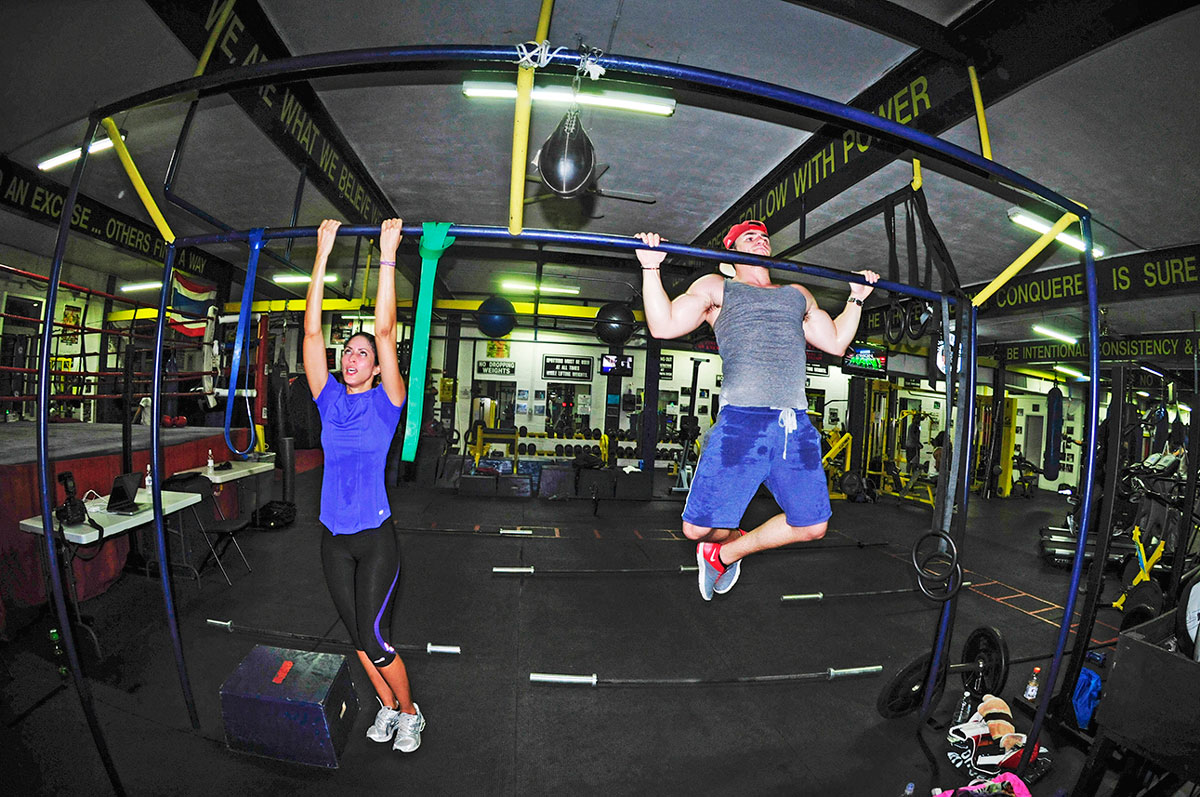
Pull-ups are one of those rare things that are awesome and horrific at the same time. They are awesome for a ton of reasons: they engage almost all the muscles in your upper body, build natural strength, represent a functional human movement, and you look badass doing them. Plus, they impress the hell out of girls (that one might be debatable… if you are a girl, though, they definitely impress guys).
Unfortunately, they also happen to suck. They require significant strength, and many beginning athletes feel that performing an unassisted pull-up is hopelessly out of reach. If you fall into this category, we have good news for you: you can learn how to do a pull-up. It is a natural human movement and well worth the struggle to learn. Regardless of your current fitness level, the following assistance program will help get you on track toward your first badass, jaw-dropping, unassisted pull-up.
Assistance Movements
The following movements will help you build the necessary strength for your first pull-up. Depending on your current fitness level, you may find yourself unable to perform some of these exercises right away. Do not lose hope! Follow the recommended reps, sets, and progressions, and give yourself time to get comfortable with the movements.
Bodyweight Rows
Bodyweight rows serve as an excellent precursor to the pull-up. They work the hell out of your lats and rear delts and demand a level of core stability similar to a pull-up. Even if you can already perform pull-ups unassisted, bodyweight rows are well worth your time.
Setup: Bring a pair of rings (or a barbell) slightly lower than chest height. To perform the standard variation, position your feet a step or two in front of the rings. Grab them and lean back until your arms are fully extended, keeping your abs and glutes tight. Unless you are an ankle mobility champion, your toes will probably come off the ground. To make the exercise more difficult, move your feet further forward.
Performing the movement: Maintaining a tight core and keeping your elbows tucked at your sides, pull yourself up until the rings make contact with your chest. Lower yourself back down to the starting position while keeping your abs and glutes tight.
Elevated Bodyweight Rows
So, normal bodyweight rows are not good enough for you, huh? Here is a tougher variation. Do the same movement, but with your feet elevated on a box. Ensure that your hips do not sag and that you maintain a tight core throughout the movement.
Banded Pull-Ups
Banded pull-ups are another great movement for building the strength needed to perform unassisted pull-ups. If you have ever taken the Cross Training class at SBB, you have probably seen these before. Ain’t no shame in using a band… for now.
Performing the movement: Loop a band around a pull-up bar and place a box next to it to help you get in and out. With your foot secured in the band, grab the bar and allow the band to assist you as you perform pull-ups. Ensure that you lower yourself until your arms are fully extended (and that your foot does not get stuck in the band when you try to get off the bar).
Negative Pull-Ups
Negative pull-ups force athletes to complete the negative phase of the pull-up (lowering your body weight) and become familiar with the feeling of hanging from the bar unassisted. (If you can already string a few together, try adding a few negatives to the end of your sets. It is an awesome way to build strength.)
Setup: Place a box next to your bar and ensure that it is high enough to get you to the top of a pull-up (if not, you can jump up). Performing the movement: Step (or jump) off the box and slowly lower yourself to the ground. Ensure that your descent is slow and controlled. Let go of the bar, get back on your box, and repeat the movement.
We know: everyone wants to be just like Pedro. Because he is such a good guy, we are going to pretend that he is not craning his neck at the top of his pull-up…. (Do not do that! We know it is tempting, but the idea of “getting your chin over the bar” is a completely arbitrary standard. It does not matter at all whether your chin goes over, as long as you get your chest near, or even better, touching, the bar.)
Jumping Pull-Ups
Jumping pull-ups likewise serve as a solid stepping stone to unassisted pull-ups, as they force athletes to complete a significant portion of the pull-up range of motion on their own.
Setup: Ensure your bar is low enough so that you can reach it with your feet on the ground. (If the bar is a little too high, just use a small box. We think of everything, huh?)
Performing the movement: Holding firmly onto the bar, jump off the ground and immediately engage your upper body to pull yourself over the bar. Depending on how hard you push off from the ground, your jump will cover some of the range of motion, but be sure to finish the movement and slowly lower yourself back to the ground. Do not just drop!
How to Incorporate These Movements
Regular, consistent training is vital to build up the necessary strength to perform a pull-up. We recommend doing assistance work at least 3 times a week in addition to your other workouts. Select 1 exercise from the listed assistance movements and perform 5 sets of the movement before or after class. It does not matter when you do it; just get it in.
Example assistance workout:
- Day 1: 5×5 Bodyweight rows (complete with feet on a 20-inch box if able)
- Day 2: 5×5 Banded pull-ups (pick a band where rep 5 is the last you can do)
- Day 3: 5×5 Negative pull-ups
- 2-minute rest between sets
Pull-Up Words of Wisdom
- No matter how tempting it may be, resist the urge to try kipping pull-ups before you have mastered strict, unassisted pull-ups. Trying to use momentum to compensate for a lack of strength is an easy recipe for injury.
- Avoid craning your neck to get your chin above the bar. Not only does it look ridiculous, but doing so compromises your spinal position and increases the chance of injury.
- Depending on your level of fitness, it could take months or even more than a year to get your first unassisted pull-up. Body fat percentage also plays a significant role here: excess body weight conspires with gravity and pulls you toward the ground like a kettlebell strapped around your waist, making pull-ups significantly harder. Do those hill sprints, burpees, or boxing classes! You get the idea.
- Do not let this happen. If it does, definitely do not post it to YouTube: